BUSINESS: Software revenue components and licensing models

We can identify five revenue-generating components for software companies. These components have a deep impact on the business model and costs structure of this kind of companies:

  • Product new license revenue: the initial fee, typically one-time charge, based on different factors: number of seats, of processors, of MIPS, of instances in memory, of granted simultaneous accesses, one-location license (eg: per data-center), company-license (eg: right-of-use within one holding, including all its subsidiaries), clustering-type, etc. The license-fee can be linked with the number of stages (integration, test, production). It works differently for the development frameworks, tools, utilities, etc. (number of developers, of simultaneous uses, etc.)
  • Product update / upgrade license revenue: fee paid usually annually for having the right to install all software updates and updgrades. A percentage of the initial license fee (product update + technical support = about 15% of the initial fee). Differenciation between major and minor updates and upgrades
  • Technical support revenue: usually an annual fee, also a percentage of the initial license fee. Included telephone support, access to a knowledge-base, web-based support, typically no on-site support.
  • Services, training and consulting revenue: one-time charge, time & material (T&M;). Daily rates, with or without expenses and infrastructure.
  • Hosting revenue (optional): for all-in-one solution where the software company proposes also the application hosting to its client (eg: salesforce.com, groove). The revenue model is typically linked with the actual usage of the application (number of business transactions) and volume discounts, which drives to a quite linear and well-known development of the costs.

There are furthermore four software licensing models, which differ from each others because of the integration or not of technical support and update/upgrade and because of the length of time for the validity of the license:

  • Perpetual license: about 90% of the licensing model worldwide, usually not included updates/upgrades and technical support or just for the first year.
  • Term license: also called lease license or rental license.
  • Subscription license: generally two types are possible: in-house installation or hosted application (eg: salesforce.com, groove)
  • Appliance license: application sold with a specific hardware (eg: firewalls)

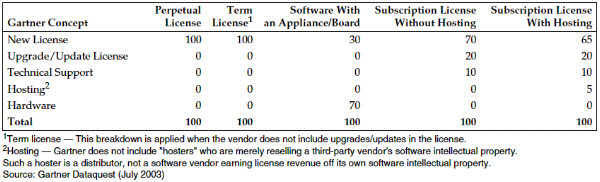
License type matrix
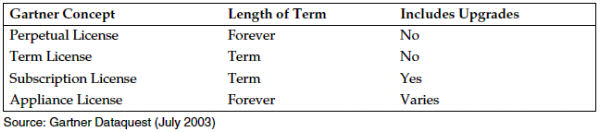
license type

Typical software business models

software business models

NEWS: American election – desolation – part II

[via Joi Ito]

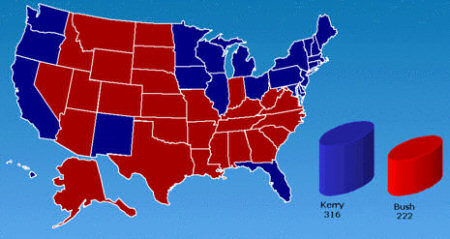
Joi said: “The people of America have failed us today”. I must correct: “52% of America have failed us today”… His analysis is *so* true, I totally agree:

[…]It’s unlikely that any sort of recount or technicality will change the fact that today, the people of the United States of America have voted for George Bush. It was close, but the Americans have chosen Bush. It’s a sad day, but in a democracy, you get the politicians you deserve/vote for. This was their chance to change their leader and they have failed. For awhile, many of us thought that they had been conned into voting for Bush – that they didn’t know he wanted to be a War President. Many people didn’t equate the US policies with the people of America. We thought they had made a mistake. Now US policies = US Citizens. You Americans have my sympathies, but it’s still your fault.

NEWS: Google’s infrastructure

[via Web Rank Info – in French]

Web Rank Info, one of the most interesting and active French website / forum specialized in Search Engines (Google, Yahoo!, etc), published a summary of a presentation made by Jeff Dean, a Google engineer who gave some inputs about the Google’s infrastructure during a colloquium at the University of Washington. You can also have a look at the entire video presentation (about 1 hour).

  • Among the 4 billion indexed pages by Google, the average size of each page is 10KB
  • On the other side, there are perhaps more than 4 billion indexed pages. Have a look at the Google’s request which seems to give back the highest results value (search of the word “the”) => today more than 6 billion!
  • Based on the 4 billion pages forecast and the 10KB per page, Google has to manage and index an incredible volume of raw data, about 40 TB, again fully indexed
  • About the costs: Google chose to use low-costs servers, i.e. a lot of low-end servers instead of some costly high-end servers. A forecast example how the business case should work:
    • Serveur IBM eServer xSeries 440
    • 8 processors Xeon 2 GHz
    • 65 GB RAM
    • 8 TB HD
    • Estimated price: 758’000$

  • Rack of 88 smaller servers
  • 176 processors Xeon 2 GHz (88 x 2)
  • 176 GB RAM (88 x 2)
  • 7 TB HD
  • Estimated price: 278’000$

You got it? You have a factor 2.7 between both estimations, with a huge difference in the delivered power, if the software architecture is able to use this distributed infrastructure correctly.

  • Response time is very important for Google, it should not exceed 0.5s. For this reason, Google has to deploy some servers everywhere around the world, in order to be “nearer” to the clients.
  • On average, each search request will use about 1’000 servers, with an average response time of 0.25s.
  • Google manages on average 250 million search requests per day.
  • Really impressive! And a good confirmation of the competitive advantage Google built with its infrastructure and platform (see my article about the Google’s platform)

    NEWS: return of the browser wars

    Good article from the MIT Technology Review about the launch of the Mozilla Foundation’s browser – Firefox v1.0 – on November 9, 2004.

    Of course, the open-source community is masterful at the art of hyperbole. But it’s also pretty masterful at building products that users—not companies—demand. That’s due in large part to the fact that it’s the users—not companies—that build the products.

    Firefox brings innovations to browser software that haven’t been since, well, since Microsoft and Netscape were trying to out-feature each other back in 1997. From little things like a local weather-related icon sitting in the page status space to the concept of tabbed pages, which make it possible to open multiple Web pages in the same window. This feature feels like a natural evolution in browsing—the ability to jump between pages within the same browser window (as opposed to opening multiple windows or continually hitting the back button).

    BUSINESS: Merge Hewlett-Packard and Compaq – Two years after

    knowledge whartonKnowledge@Wharton published an analysis – The H-P Compaq Merger Two Years Out: Still Waiting for the Upside – about the results of the merge between Hewlett-Packard and Compaq for a while. Interesting to see that there are still two different entry points for the new company (hp.com, compaq.com)…

    hp compaq

    Different quite opposite views are expressed in this, which shows that it is still difficult to know after 2 years is this huge merge was/is worth or not.

    George Day

    “Wall Street may say, “Break the damn thing up’. Analysts [often] have good insights, but they made the same proposal in 1992 when Gerstner came on board. It’s a nice parallel. Gerstner was confronted, when he first arrived, with the idea of, ‘Let’s break up IBM into six or seven different businesses.’ Well, it would have been the worst possible decision for IBM. If Carly’s going to make this thing work, she’s going to have to do something like Gerstner did: pull things together and create solutions at the level of market segments. Each part of the organization that reaches the customer should have the autonomy to pull together whatever the customer wants, supported by product groups. That’s not a bad strategy. H-P is really a product-centric company. If they can move to become a customer-focused company, with the products feeding into those customer groups, then they may have a chance. But the problem with that strategy is we have a player [IBM] that’s already done that. HP is trying to be cost competitive with Dell and be the same kind of integrated-solutions provider that IBM has become. If that doesn’t work — if it’s clear IBM has too big a lead — then HP, which has this hugely profitable printer business, has to think about breaking up.”

    Saikat Chaudhuri

    “H-P has to be more focused on its marketing, not just saying, ‘We provide everything,’ but ‘We can cater to all your needs and this is how were going to do it.’ The beautiful part of IBM’s e-Business strategy is everything else can revolve around it. The challenge for H-P is to extend its brand. High quality and innovation need to apply to servers, services and storage systems as well as PCs.”