BUSINESS: the top 1’000 things to learn

[via Seth Godin]

So what are they? What are the one thousand teachable things that every third grader ought to start learning so she’ll know them all before before she graduates from high school?

Here are twenty to get us started.

  1. How to type.
  2. How to speak in front of a group.
  3. How to write clear prose that other people actually want to read.
  4. How to manage a project.
  5. The most important lessons from American history.
  6. What the world’s religions have in common.
  7. Evolution.
  8. Formal logic.
  9. The 15,000 most common English words.
  10. Conversational Spanish.
  11. How to handle big changes, with grace.
  12. How to run a small business.
  13. Basic chemistry.
  14. Not arithmetic, but algebra.
  15. A little geometry, a little calculus.
  16. The most important lessons from ten other world cultures and their history.
  17. Speed reading with comprehension.
  18. How to sell.
  19. Pick one: how to paint, write a poem, compose a song or juggle really well.
  20. Understanding the biographies of 500 important historical figures and 200 fictional ones.

BUSINESS: The Bootstrapper’s Bible – Seth Godin (01)

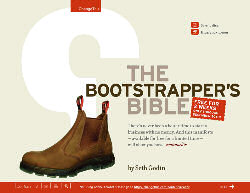
The Bootstrapper's BibleI’ve started to read very conscientiously the new e-book of Seth Godin for a while. This book is really great. I will surely publish some insights in the coming days. What’s also great is that The Bootstrapper’s Bible was available online for free during 2 weeks. The book is licensed under a Creative Commons Attribution – Non Commercial – No Derivs license. And, Seth gives an explicite authorization to spread his work electronically!

You are given the unlimited right to print this manifesto and to distribute it electronically (via email, your website, or any other means). You can print out pages and put them in your favorite coffee shopʼs windows or your doctorʼs waiting room. You can transcribe the authorʼs words onto the sidewalk, or you can hand out copies to everyone you meet. You may not alter this manifesto in any way, though, and you may not charge for it.

So, you can find a PDF copy of The Bootstrapper’s Bible of Seth Godin here.

Who is Seth Godin?

Seth Godin is a bestselling author, entrepreneur and agent of change. In Free Prize Inside, his follow up to the best selling marketing book of 2003, Purple Cow, Seth helps you make your product remarkable with soft innovations. You need to make each of your employees idea champions so they can find the Free Prize. Godin is author of six books that have been bestsellers around the world and changed the way people think about marketing, change and work. Seth is a renowned speaker as well. He was recently chosen as one of 21 Speakers for the Next Century by Successful Meetings and is consistently rated among the very best speakers by the audiences he addresses. He holds an MBA from Stanford and was called “the Ultimate Entrepreneur for the Information Age” by BusinessWeek.

WEEK-END: Frozen trees and Sea of clouds

As the weather was again awful – the fog is blocking the nice sunny weather since days, we decided to proceed further and to make a tour in the mountains, over this annoying clouds. That was definitely a good idea :-)

-4°C at home when we left (altitude: 230m) and +8°C when we arrived at “Le Grand Ballon” (altitude: about 1’300m!). Have a look!

Frozen trees

week-end

week-end week-end

week-end

Sea of clouds

week-end

week-end

week-end

NEWS: incredible pictures

[via vowe]

Have a look at the Norio Matsumoto Gallery about Nature:

  • The Alaskan range
  • Northern lights
  • Whales of Southeast Alaska
  • Alaskan Forest

Really *marvelous*!! I would like to publish three of them (it was difficult to choose…), just to convince you (if I’m damaging any copyright, let me know, I will put them back)

Norio Matsumoto

Norio Matsumoto

Norio Matsumoto

PS: for a time, an interesting use of the Flash technology on the Norio’s website.

BUSINESS: IBM selling PC business? It’s done

[via BetaNews]

Rumors are confirmed…

IBM has officially confirmed it will sell its PC business to Chinese computer maker Lenovo for a total of $1.75 billion. […]

Lenovo will pay IBM $650 million in cash, another $600 million in common stock, and assume $500 million in debt from Big Blue. IBM will become Lenovo’s second largest shareholder with a stake of 18.9 percent in the company, and over 10,000 IBM employees will migrate to Lenovo.

The deal creates the third-largest PC company in the world behind Dell and Hewlett-Packard. Lenovo will receive a 5-year license to use the internationally recognized IBM brand name and “Think” trademarks on its desktop and notebook PCs.

Lenovo’s new PC business will be located in the United States, with headquarters in New York and principal operations in Raleigh, North Carolina, where IBM currently handles PC development. Stephen Ward, current IBM senior vice president and general manager of IBM’s Personal Systems Group, will become CEO of Lenovo. Current Lenovo CEO Yuanqing Yang will become Chairman of the company.

BUSINESS: 17 common mistakes to avoid and 5 tips for Entrepreneurs

[via entrepreneur.com]

Mistake 1: Failing to spend enough time researching the business idea to see if it’s viable.

Mistake 2: Miscalculating market size, timing, ease of entry and potential market share.

Mistake 3: Underestimating financial requirements and timing.

Mistake 4: Overprojecting sales volume and timing.

Mistake 5: Making cost projections that are too low

Mistake 6: Hiring too many people and spending too much on offices and facilities.

Mistake 7: Lacking a contingency plan for a shortfall in expectations.

Mistake 8: Bringing in unnecessary partners.

Mistake 9: Hiring for convenience rather than skill requirements.

Mistake 10: Neglecting to manage the entire company as a whole.

Mistake 11: Accepting that it’s “not possible” too easily rather than finding a way.

Mistake 12: Focusing too much on sales volume and company size rather than profit.

Mistake 13: Seeking confirmation of your actions rather than seeking the truth.

Mistake 14: Lacking simplicity in your vision.

Mistake 15: Lacking clarity of your long-term aim and business purpose.

Mistake 16: Lacking focus and identity.

Mistake 17: Lacking an exit strategy.

Is there any difference between doing nothing wrong and doing everything right? Peter Russo, director of Boston University’s Entrepreneurial Management Institute, says that while you’re avoiding John Osher’s 17 mistakes, you should also try to do five key things right. “If you do those five things, you’re probably not going to make those other mistakes,” he says. Here are Russo’s five things start-ups should do:

1. Know your goals for the venture. “A lot of people see an opportunity without ever asking themselves what they’re doing it for,” says Russo. “Are they trying to make a quick buck? Create a legacy? Have a lifestyle? There are a lot of reasons. It’s critical that you know from the beginning what your goals are, because everything else is going to revolve around that.”

2. Recruit and hire the best people. “It sounds almost cliché now to say I’d rather have an A team with a B idea than a B team with an A idea. The right team can fix a lot of problems. If you don’t have the right team, you don’t have much of a chance,” Russo says. “Get the best people available at the time.”

3. Develop a forgiving strategy. “Things are going to go wrong,” he says. “They’re going to be harder, take longer and cost more money than you think. You have to have a strategy to survive. A lot of people put together a plan that will work only if everything goes right. It’s not going to.”

4. Be honest with yourself. “Recognize shortcomings, weaknesses and problems immediately. Do not ignore them or try to talk yourself out of them,” Russo says. “Address them head-on.”

5. Commit to the business. “You can’t really do anything significant without fully committing yourself to it. A lot of people try to dabble,” he explains. “They think they’ll do it part time [and] see how it works out. If you plan to be successful, you have to commit.”

BUSINESS: IBM selling PC business?

[via BetaNews]

New era?

IBM has put its consumer PC unit up on the auction block, refocusing its efforts on the more profitable corporate server and computer service markets, according to a report in the The New York Times. The sale would likely include all of Big Blue’s desktop workstations and ThinkPad portables, for an estimated price range of $1 billion to $2 billion. Sources tell the Times that Chinese computer maker Lenovo — formerly Legend — is the current top bidder for the business unit that represents 12 percent of IBM’s $92 billion annual revenue.