
BUSINESS: Microsoft vs. Apple – online music

apple microsoftVery interesting article from Knowledge@Wharton about the future competition between Microsoft and Apple in the field of the online music.

  • The overall digital music sales market represents in 2004 about $270 million. By 2009, this market will represent 12% of consumer music spending, i.e. $1.7 billion! (Source: JupiterResearch)
  • The current market situation cannot be clearer: Apple holds 70% of the market share with iTunes. It sold 125 million songs since the launch of the Windows version in 2003. Apple offers today a catalogue of about 1 million songs.
  • Though this strong strategic starting position, Apple could be confronted with at least two strategic possible issues in the future: first, Apple can repeat the same error as in the past with its OS and the Macintosh, i.e. a closed system which works exclusively with its own Hardware ; second, iTunes is only a download platform, it seems that no streaming functionality is planned…

Some extracts:

Wharton professors say that Apple, by not opening its iTunes format to other music players, could be repeating the mistake it made with its operating systems (OS) for Apple and Macintosh computers back in the 1970s and 1980s. The fact that Apple’s OS software was a closed system that worked only with its own hardware – in contrast to Microsoft, which licensed its operating system software widely and eventually emerged as the industry standard – isolated Apple.

If Microsoft and other services can convince consumers that monthly subscription services are better than downloading songs a la carte, Apple could face problems since it apparently has no plan to offer a streaming music service.

“Microsoft will ultimately be cheaper because it’s not out to sell hardware,” says Clemons. “It usually starts out badly in a new market, but then it either gets better or it terrifies the competition.” Usually it does both.

Outch!

NEWS: “China’s growth is a tougher event than anything we faced since World War Two”

Loic posted a great article about the economical development in China on last Sunday. If you think that China is going to have an impact on us – or specially if you don NOT think so – I recommend strongly the reading of this article!

Some extracts:

China has grown at 8% per year for many years, it is the sixth economy in the World. The standard of living has improved dramatically with an average per capita income above $1000, it was only $300 twenty years ago. 400 million Chinese are now above the global poverty line.

What strikes me the most is how unprepared the US and Europe are to China’s growth. The impact of China’s economic development is now already huge on the Global Economy. The first consequence that is very often seen is of course jobs being transferred to China but the impact of China’s internal demand for energy for example is equally important, China is for example now the second largest importer of oil and second largest electricity consumer. This has an impact on global energy prices and it will only increase.

The technology education available in China is according to Robert to World Class Standards. China graduates 2 to 2.5 million students a year and 60% of them are in the technology sector, where India graduates 1 million for 50% in technology and the USA 2 million a year with only 25% in technology.

We mostly think about toys or clothes production when we think about China. China has become the manufacture of the World but with such high standards of education and such a high number of highly qualified technology graduates China is now ready to move to the next step and create World Class leaders and companies. It would be a big mistake to consider China’s competition to the US, Europe and Japan as low cost subcontracting capabilities only.

Seen from the US and Europe, the threat is generally understood as loosing jobs subcontracted in China. It should probably be understood more as new fast moving Chinese companies created and not only addressing their local market but becoming new leaders.

WEEK-END: Monkey Mountain

monkey mountainGreat visit today in an impressive and beautiful place!


Monkey Mountain is more than 280 monkeys living in total freedom in 24 ha of forest and meadow. Walking along the paths, you are transported into a different world through direct contact with the monkeys who don’t hesitate to come and take the popcorn, distributed at the entrance, from the palm of your hand.

The path takes you through a splendid forest; a 24 ha protected area where the monkeys live. Forest paths, cleared and laid out for visitors, take you through the park, leaving large areas reserved for the animals, space they need to rest in peace and quiet.

Barbary Macaques are today considered an endangered species. […] A recent estimate of the living population shows that the wild population represents 10’000 monkeys in Algeria and Morocco (down from 23’000 in 1978). The Monkey Mountain is strongly committed to the protection of the species by :

  • raising public awareness of the protection of Barbary Macaques by presenting them in a setting very similar to their natural habitat
  • developing educational actions (see inter-active boards and games, booklets, guides, etc)
  • creating and preserving an invaluable genetic pool with the population present in the park
  • strengthening wild populations by re-introducing entire groups of monkeys. Ever since the Park opened; some 600 monkeys coming from our three parks were reintroduced into their natural habitat Atlas Mountains in Morocco.
  • Source: Monkey Mountain

    PRIVATE: In memory….

    Already the third anniversary of the September 11, 2001 attack of the Twin-Towers. Some pictures are better than words.

    These pictures were taken by Bill Biggart (excepted the last one) who died when the second Tower felt down. I recommend you to have a look at the Bill Biggart’s last exposures. Very impressive.

    Bill was killed when the second building came down, and he was crushed under all the debris. I don’t know if he jumped back under the underpass, or whether the direct debris killed him. We know in his last picture he was working to the very end, and that’s telling of the commitment he had to his work.

    BUSINESS: Knowledge-sharing based on weblogs (03)

    Weblog-Conversations

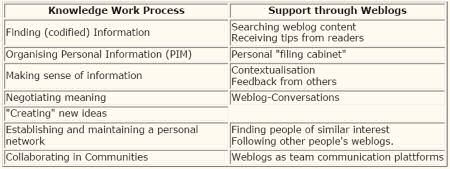
    Weblogs form networks between eachother: Webloggers read other weblogs and will often use this material to write up own pieces. A free-flowing conversation ensues between the authors and members of the audience who chime in. Technologies such as “TrackBack” (which displays “inbound links” to a particular post, that is: references to a particular post from other entries in other locations that reference it) or referrer-lookup (analysing where traffic came from, made possible by analysing server-logfiles or special web-based tools, such as technorati.com) make it possible to track these discussions across multiple weblogs. New participants can join the discussion anytime by commenting or writing an entry on their own weblog. These conversations are self-organising and only moderated decentrally by the individual weblog-authors.

    Weblogs and Networking

    By reading someone elses weblog readers get to know the writer very well. It can be seen that webloggers who read eachother and use their weblogs to converse with eachother are building up trust. As a consequence, they are collaborating and forming networks (see Zijlstra, 2003).

    Weblogs can be seen as a “Personal Presence Portal”: They are an online representation of a knowledge worker’s presence and serve as an access point to his work and thoughts. Also, they provide access to other forms of getting in contant, such as email, instant messaging or meeting face-to-face. (Zijlstra, 2004)

    Conclusion


    Source: Knowledge Work Processes and Support for them through Weblogs

    MUSIC: On heavy rotation

    I really appreciate very much Pat Metheny, an incredible Jazz guitarist and a very kind and humble person, at a minimum on stage ;-) I bought recently a DVD of one of its concert with the Pat Metheny Group (PMG): Imaginary Day, recorded live and filmed in 1998 at the Mountain Winery in Saratoga (USA, California). Pat is technically and melodically an extraterrestrial, so good! The band is doing a very good job in the background, special mention to Lyle Mays, the pianist. The sound quality and rendered surround-mix is execellent. The production is…quite bad, so to speak, funny! As when you are discovering and testing the visual effects and transitions of Adobe Premiere for the first time :-) Anyway, all in all, a very interesting DVD and musical experience with Pat Metheny!

    I’ve seen Pat for a while in another band-context – his Trio – during the last Montreux Jazz Festival.

    BUSINESS: Knowledge-sharing based on weblogs (02)

    Email client as a knowledge management tool?

    “Email is often described as “the killer application of the Internet”. Based on our research, we think it is possible to be even more emphatic; email is a serial-killer application! It is seriously overloaded and has been co-opted to manage a variety of tasks that it was not originally meant to support.” (Ducheneaut & Bellotti, 2001)

    Weblogs as a Personal Filing Cabinet

    A weblog can serve as a personal “filing cabinet” of information (Pollard, 2003a). By “blogging” items – that is: referencing and citing pieces of information, annotating them and publishing them on a weblog – a weblog author (“blogger”) can build up his own personal information repository. The simplicity of the weblog system encourages filing and annotating things that were previously left unfiled. Ths structure of hyperlinks and free text and the absence of imposed hierarchy makes it possible to archive items that could not be organised well in file systems.

    By linking to older entries in one’s own weblog or to other items found elsewhere, the user can build his own personal information structure that is tailored to his needs. When working on a specific task the weblog becomes the starting point of a search for information.

    Weblogs as Knowledge Journals

    Journal writing has always been an important task of learners and knowledge workers. Taking notes of things learned and expatiating thoughts is an important process to intensify learning (Kerka, 1996). Weblogs can serve as a medium in which to record ideas and thoughts and reflect on current work and things learnt. They become “representations of patterns of meaning” (Fiedler, 2003) or: representations of knowledge.

    Weblogs and Feedback

    Weblogs are published in public or at least to a defined audience. Weblog-authors are therefore not only using weblogs as personal journals but also to get feedback on their thoughts. Often, weblog-authors will publish “half-baked ideas” to get feedback on them and develop them into something more meaningful. Also, readers will often help an author with tips on where to find more information on a topic blogged about.

    Source: Martin Röll

    BUSINESS: Knowledge-sharing based on weblogs (01)

    Interesting article (html, pdf) from Martin Röll, the content was presented during the BlogTalk 2.0 in Vienna-Austria on July 2004. As the author of the paper, I am convinced that an email client cannot be the base of proper knowledge management. Some important mandatory functionalities are simply missing. I agree also with his analysis when he says that weblogs could and should be used as a central personal knowledge management tool. In this field, I will also post some comments and inputs about the usage of Groove and its new version in the coming days.

    Some abstracts of the article:

    Knowledge work processes


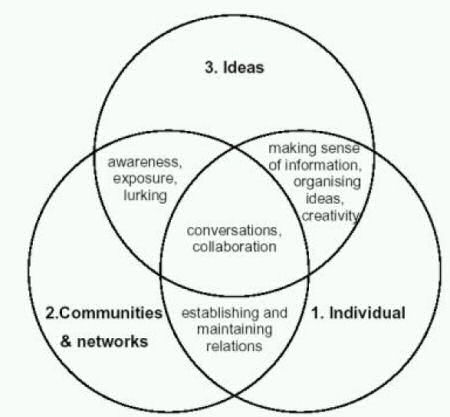
    Source: Framework for Knowledge Work Analysis (Efimova, 2004)

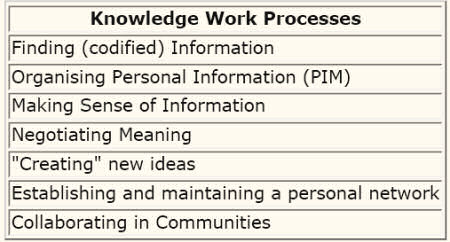
    From this framework the following processes can be identified:

  • Organising personal information (“Personal Information Management”)
  • Making sense of information (personal)
  • Negotiating meaning (social)
  • “Creating” new ideas
  • Establishing and maintaining a personal network
  • Collaborating in communties
  • Finding (codified) information


  • Source: Knowledge Work Processes (own illustration, based on Efimova, 2004)