BUSINESS: the 2nd mainframe in Europe

I visited one of the datacenter of Triaton in Frankfurt (Germany) yesterday. Quite impressive! We had a chance to have a look at the second mainframe which was installed in Europe! This installation happened in 1957-58 by the Hoechst chemical company. It was a 701 model. The goal was to organize better the payroll system. Already a Business Process Re-engineering project ;-) I was surprised that IBM already had more than 80’000 employees in 1957…

I couldn’t take some pictures but I found some funny and interesting pictures and information on the IBM’s website. Have a look at these pictures and the incredible power of this machine!

Overview of the mainframe (the one we saw was bigger)

The incredible control panel

The magnetic core storage unit

The vacuum tubes

System performance

  • Electrostatic storage capacity: 20,480 digits.
  • Magnetic drum capacity: 81,920 digits.
  • Magnetic tape capacity: More than 8 million digits without changing tape.
  • Addition and subtraction: More than 16,000 operations per second.
  • Multiplication and division: More than 2,000 operations per second.
  • Tape reading and writing speed: 12,500 digits per second.
  • Drum reading and writing speed: 8,000 digits per second.
  • Printed output: 180 letters or numbers per second.
  • Punched card input: 600 digits per second.
  • Punched card output: 400 digits per second
  • Source: IBM model 701 exhibits

    NEWS: Interview with Mena Trott

    Digital Web Magazine published an interesting interview with Mena Trott – co-founder and owner of SixApart – about SixApart itself, Movable Type and the blogging tool market. To be read!

    DigitalWeb: How do you characterize the nature of the competition between you and Blogger and WordPress, and some of the other folks out there? Is it collaborative, with everyone wanting to grow the whole industry in an effort to get a piece of a bigger pie, or is it becoming more competitive?

    Mena Trott: It’s hard. We and Blogger are both very focused on what we’re doing. In terms of knowing people, we talk to the Blogger team a lot and are on very good terms with them. We both have such different markets. When you have a free product and a subscription product in the same market, there is overlap, but it’s not cutthroat. In terms of collaboration, there can be more.

    Unfortunately, we’re given a rap because we are so dominant, I guess, in terms of use. People see us as this big guy who they want to bring down, oddly, when we really aren’t—we’re still a small company. That’s frustrating. We’re more than willing to work with people. Being big and corporate completely goes against the things the company is all about.

    TOOLS: beta-test Perfect Disk v7.0

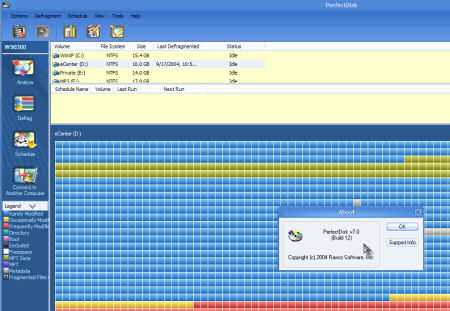
    I’m testing the beta version 7.0 of Perfect Disk from Raxco since yesterday. Already published a review of the version 6.0 of Perfect Disk.

    It seems that the guys from Raxco did a good job! New features:

  • 20% less memory consumption
  • Improved speed on larger drives
  • Improved user interface
  • Support for mount points
  • Network Configuration Management Wizard – Allows you to globally set most of PerfectDisk’s registry keys without using Active Directory.
  • NEWS: working session in Zurich – part III

    For chance, Laurent (this URL is crazy!) told me before that I forgot to mention in my last post about our wakeboard experience on the lake of Zürich that I was talking about THE Laurent of the very well-known French site about .NET technology called Tech Head Brothers. To be sure that there is no possible misunderstanding remaining, I publish again the picture of Laurent (you know, this Laurent), trying to initiate a new kind of wakeboard-style called “submarine wakeboard”.

    PS: Laurent, I know, there will be some reprisals from your side ;-) Anyway!

    BUSINESS: Corporate Governance by the numbers….

    WhartonThree professors of Wharton tried to find out if it possible to quantify and to measure the quality and efficiency of Corporate Governance.

    For chance, the answer is clearly NO. A kind of common sense, I think… Some extracts:

    “Lots of people are coming up with governance scorecards […] They’re coming up with best practices and selling this stuff. As far as we can tell, there’s no evidence that those scorecards map into better corporate performance or better behavior by managers.”

    [The three professors] do think corporate governance matters, but after puzzling over reams of company numbers, they are not confident that anyone can measure whether one firm’s governance is better than another’s at least, not by using typical metrics.

    I specially like this one:

    In the absence of effective measurement tools, investors who are trying to assess firms’ governance have to do it the old-fashioned way. That is, they have to do their homework, examining companies one at a time.

    Source: Corporate Governance by the Numbers: It Doesn’t Work

    NEWS: working session in Zurich – part II

    Some days ago, I explained that we had some fun in Zürich with some of my colleagues. We began with a McDo, have a look here :-) After the McDo, we did some wakeboard on the Zurich’s lake. Lorenz was really good:

    I could start after the third try, somehow still “tense” :-)

    Laurent tried a new kind of wakeboard called “submarine wakeboard”, also named “plouf wakeboard” ;-)

    NEWS: IBM is sometimes … so funny :-)

    [Via vowe]

    IBM can be really funny and, in a way, completely ridiculous.

    Although IBM is very strongly implemented in the industry I’m working for (insurance), we are using succesfully BEA Weblogic since more than 4 years. I must say I really like the contacts we had with this company and the technology vision they are implementing. A great integrated product!

    On the other side, you have IBM with its Websphere product-line, not really integrated (at least ;-), not very convincing to my mind, but quite a good success on the market. Now the following example – how to enable security in a Websphere portal – is really convincing me that we are on the good way ;-) I know, I know, it’s just an example… Do not forget to have a look at the last sentence – These steps are not supported and are provided as is. The cherry on the cake :-)

    Installation for LDAP setup:

    —————————-

    1. Install WebSphere Application Server Developer.

    2. Update WebSphere Application Server Developer to Version 5.1.0.1

    3. Install interim fixes.

    4. Install Portal Toolkit and test environment.

    5. Update WebSphere Portal to Version 5.0.2 by installing Fix Pack 2.

    6. To set up the test environment (Test1) . perform these steps:

    a. Start the workbench.

    b. Create a portal through wizards.

    c. Deploy that portlet in the test environment without security enabled.

    7. Setup the wpconfig.properties file with the following parameters (use defaults for all other parameters):

    – WasUserid=uid=wpsbind,cn=users,dc=ibm,dc=com

    – WasPassword=wpsbind

    – PortalAdminId=uid=wpsadmin,cn=users,dc=ibm,dc=com

    – PortalAdminPwd=wpsadmin

    – PortalAdminGroupId=cn=wpsadmins,cn=groups,dc=ibm,dc=com

    – LTPAPassword=wpsbind

    – LDAPHostName=amtam.itso.ral.ibm.com

    – LDAPAdminPwd=

    – LDAPBindID=uid=wpsbind,cn=users,dc=ibm,dc=com

    – LDAPBindPassword=wpsbind

    – LDAPSuffix=dc=ibm,dc=com

    8. After LDAP configuration, execute the wpsconfig.bat tasks

    stop-portal-server, stop-admin-server

    9. Start WebSphere Portal by executing wpsconfig.bat task start-portal-server and logon.

    10. Stop the portal server again and start the existing server in WebSphere Application

    Studio Developer.

    11. The server start will fail. (Note: there are no security settings yet. Even if you manually

    insert security settings, the server start still fails.

    12. Delete the existing test server and create a new one. Security settings will be

    automatically inserted. Start the test server.

    These steps only work if the wpsadmin password is wpsadmin. If you change the password, you need to update the wps-info.xml file. The userid and password in a server configuration are stored in the following file:

    servers\YourServerName.wpc\wps-info.xml

    The password is encrypted. If you remove {xor} from the line of password, you can input the password in ASCII directly, such as: wpsadmin.

    These steps are not supported and are provided as is.